


History
1. Statement of Intent
One of the main objectives of teaching History, Geography and Beliefs and Values is to help pupils to make sense of their present in the context of the past, their environment and their beliefs. Humanities teaching embeds skills in pupils to enable them to develop into well rounded and informed citizens. We will ensure that pupils are taught the importance of understanding the diversity of others and to be tolerant of the choices of others. They will be encouraged to question, make reasoned judgements and form their own opinions.
Humanities lessons are planned to be creative, interesting and stimulating for all pupils to ensure that a love of learning is developed for life. The lessons are challenging, stretching and will give pupils the space to grow in confidence with written, oral and group work.
2. The National Curriculum
The National Curriculum for History aims to ensure that all children:
- know and understand the history of these islands as a coherent, chronological narrative, from the earliest times to the present day: how people’s lives have shaped this nation and how Britain has influenced and been influenced by the wider world
- know and understand significant aspects of the history of the wider world: the nature of ancient civilisations; the expansion and dissolution of empires; characteristic features of past non-European societies; achievements and follies of mankind
- gain and deploy a historically grounded understanding of abstract terms such as ‘empire’, ‘civilisation’, ‘parliament’ and ‘peasantry’
- understand historical concepts such as continuity and change, cause and consequence, similarity, difference and significance, and use them to make connections, draw contrasts, analyse trends, frame historically-valid questions and create their own structured accounts, including written narratives and analyses
- understand the methods of historical enquiry, including how evidence is used rigorously to make historical claims, and discern how and why contrasting arguments and interpretations of the past have been constructed
- gain historical perspective by placing their growing knowledge into different contexts, understanding the connections between local, regional, national and international history; between cultural, economic, military, political, religious and social history; and between short- and long-term timescales.
3. Lesson Structure
A typical Humanities lesson will start with greeting and welcoming the class.
The learning objectives of the lesson are introduced and a challenging key question for the lesson will be discussed.
Through a range of different activities, pupils’ progress and understanding will be assessed during the lesson. Pupils are encouraged to share their views and opinions openly in Humanities lessons to develop a sense of self and awareness of the world around them.
Homework is set via big projects on a termly basis across the Humanities Department – enabling pupils to study topics in more depth and using different creative outlets.
4. Curriculum Implementation – Planning and Teaching
- Children in Years 5 and 6 have two 55 minute timetabled lessons of History or Geography a week – with this swapping on a termly basis.
- Children in Years 7 and 8 have one 55 minute timetabled lesson of History and Geography a week.
- All children in Years 5, 6, 7 and 8 have one timetabled lesson of Beliefs and Values a week.
All pupils will experience a wide variety of teaching and learning styles and will be able to study Humanities using the following:
- Role play, drama
- Thinking skills tasks
- Independent study and enquiry
- Production of display work
- Group activities
- Extended homework projects
- The use of ICT
- Site visits
- Examination of artefacts and historical images
Purpose of Study – History
A high-quality history education will help pupils gain a coherent knowledge and understanding of Britain’s past and that of the wider world. It should inspire pupils’ curiosity to know more about the past. Teaching should equip pupils to ask perceptive questions, think critically, weigh evidence, sift arguments, and develop perspective and judgement.
History helps pupils to understand the complexity of people’s lives, the process of change, the diversity of societies and relationships between different groups, as well as their own identity and the challenges of their time.
5. Impact and Assessment
Pupils are assessed continually throughout the year and provided with whole class feedback, individual feedback, marking and assessment tasks. Assessment grids are used to show pupils the different stages of development there are and how they can continue to progress and improve their understanding.
Pupils are confident with self and peer assessment and know how to set themselves targets to improve their work.
In KS2, pupils are mainly assessed through teacher assessment.
In KS3, pupils are assessed through teacher assessment, mini assessments within each unit and end of year assessments.
6. Cultural Capital
Departmental links – The Humanities and English Department work closely to ensure clear links within literacy are established across the Humanities subjects. In KS3 at the start of each topic key spellings are introduced to pupils to ensure key words are established and embedded. Key points of literacy focus are identified within the department and techniques used by the English department have been shared and are used within Humanities lessons to ensure continuity across the school.
Links within the Trust – St Mary’s CE First School and Brewood CE Middle Academy work closely to share good practice and the Spiritual Ambassador group at Brewood are developing these links – by visiting our First school and taking lead roles in activities based around Christian festivals such as Easter.
Links with our local community and environment – The Humanities Department has set up an annual challenge for our Y8 students – the Climate Enterprise Award. Pupils work in lessons and outside of school to develop a project to help improve our school environment and make the world a better and safer place. Volunteers from the local community and federation judge the Climate Enterprise Award with the winning group’s proposal is implemented within the school grounds.
Extra-curricular – Visits are seen as a vital part of the Humanities Department in expanding pupils’ experiences and knowledge of the wider world. In KS2 pupils experience enrichment days – spending a day in the life of a Victorian and during the Blitz. Year 6 are lucky enough to have a VR experience on the Mayans this year – bringing ancient civilisations back to life. Year 7 take part in off-site fieldwork studies and Year 8 attend an experience at the Black Country Living Museum.
Diversity – Here are Brewood we believe the Humanities subjects teach empathy, cultural awareness, cultural competence, and how to communicate clearly — both in a written form and orally. A wide range of subjects, cultures and faiths are explored to ensure we develop and nurture respectful, resilient and caring global citizens.
7. Inclusion – Equal Opportunities and SEND
At BMA we are committed to promoting equal opportunities irrespective of socio-economic background, gender, disability and ethnicity in all areas of the curriculum. We believe all children should have access to and participation in the learning of the Humanities subjects and to be supported in this process.
8. The Subject Leader
The subject leader is responsible for the planning and coordinating of the Humanities curriculum. The subject leader also:
- Plans collective worship across the school for all pupils on a daily basis.
- Coordinates the Spiritual Ambassadors team to encourage all pupils to have a voice.
- Works with the LDBE advisors closely.
- Attends Humanities Middle School network meetings to share good practice.
- Supports colleagues in their teaching, by keeping them informed of new developments.
- Writes a subject development plan each year informed by the whole school development plan.
- Attends specialist courses and ensures content is disseminated to staff.
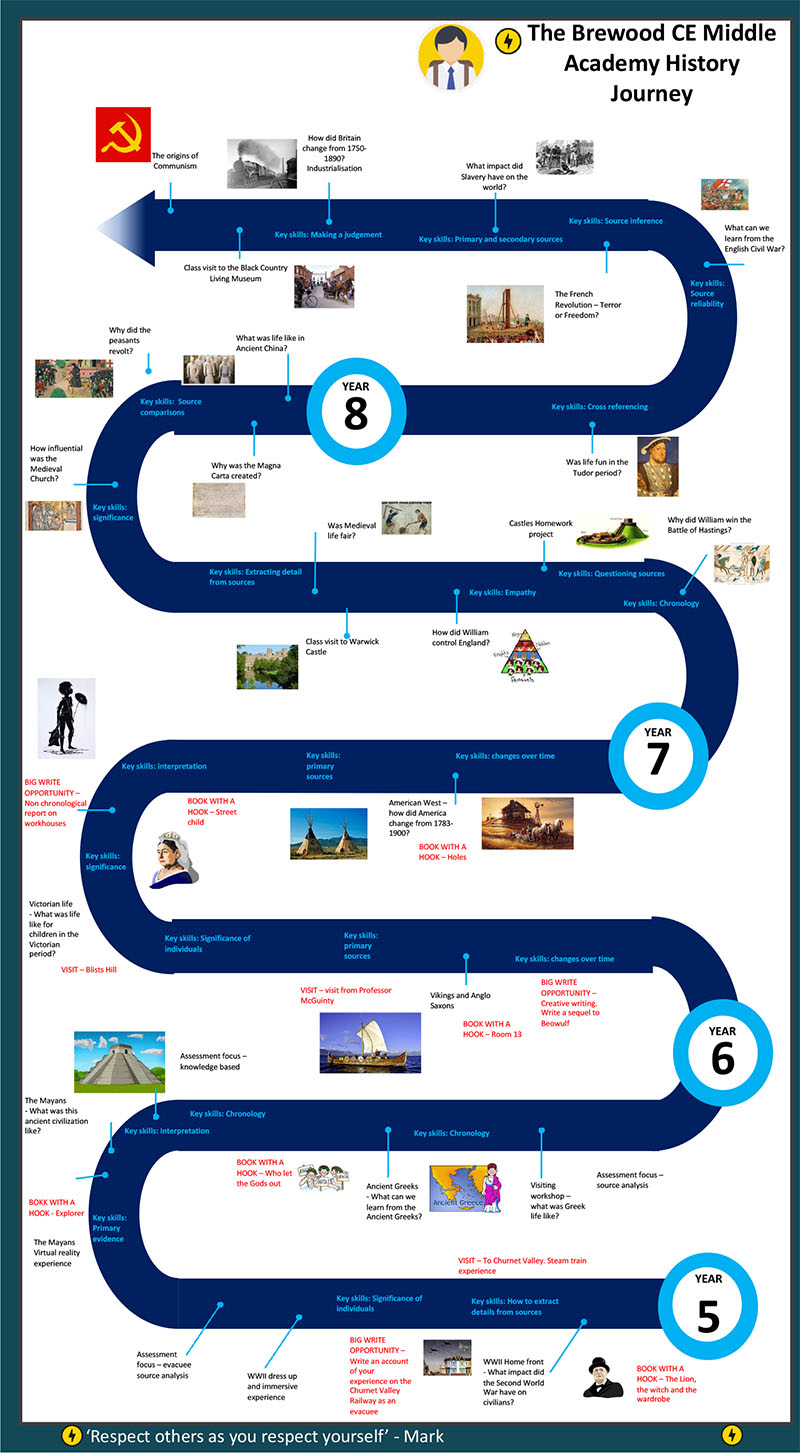
9. Overview Document
10. Humanities Policy


Pupils are happy at Brewood Middle CofE Academy and many describe it as being like a ‘family’
Should you require any of our school information in a paper format please contact our office on 01902 850266

CONTACT INFORMATION
Trust Head Teacher - Mr J Smith
Brewood CE Middle Academy
School Road
Brewood
Stafford
ST19 9DS
Telephone - 01902 850266
Facsimile - 01902 851332
office@brewood.staffs.sch.uk
Inclusion Lead - Mrs L Guy 01902 850266
COLLABORATIONS


